The Art of the 'Somatic Reset': Quick Nervous System Shifts for Busy Professionals


It is 2:30 PM on a Tuesday. You have three back-to-back client calls, your inbox is overflowing, and you can feel a subtle tightness creeping into your jaw and shoulders. Your heart rate is elevated, your breath is shallow, and your focus is scattering.
Standard self-care advice usually suggests stepping away for a 45-minute walk, meditating for 20 minutes, or taking a bubble bath. But when you are in the middle of a demanding workday, those options simply aren't practical. You need a way to reduce stress right now, without stepping away from your desk.
This is where somatic resets come in.
What Is a Somatic Reset?
The word "somatic" comes from the Greek word soma, meaning "of the body." Traditional stress-management strategies often rely on a top-down approach: trying to use your conscious mind to convince your body that everything is okay ("Just relax," "Stop overthinking").
However, when your nervous system is dysregulated, top-down logic rarely works. The emotional center of your brain operates much faster than your rational thoughts.
Somatic resets use a bottom-up approach. Instead of using your mind to calm your body, you use specific physical movements and physiological triggers to send safety signals directly back to the brain.
The Science in Short: Somatic exercises shift your autonomic nervous system out of a sympathetic state (fight-or-flight) and into a parasympathetic state (rest-and-digest).
By using the body's natural reflexes, you can slow your heart rate, drop your cortisol levels, and regain mental clarity in less than two minutes.
3 Desk-Friendly Somatic Resets You Can Do Anywhere
You don't need a yoga mat, dim lighting, or quiet surroundings to regulate your nervous system. Here are three simple, science-backed somatic techniques you can use during your workday:
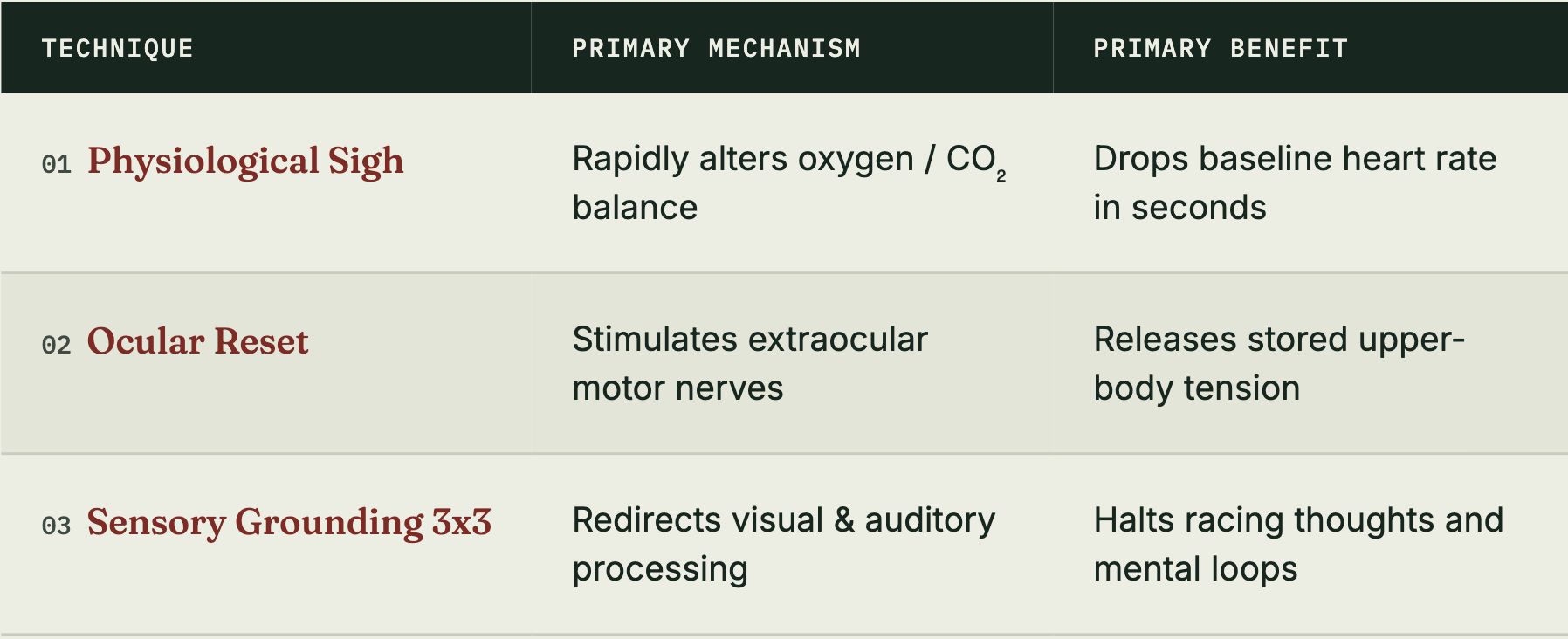
1. The Physiological Sigh
Popularized by researchers at the Huberman Lab at Stanford University School of Medicine, the physiological sigh is the fastest science-backed way to reduce biological arousal in real time. It is a double inhale followed by an extended exhale—a pattern your body uses naturally when sleeping or crying to re-balance oxygen and carbon dioxide levels in the lungs.
- How to do it:
- Take a deep, rapid inhale through your nose.
- At the very top of that inhale, sneak in a second, short "top-off" inhale to fully inflate the tiny air sacs (alveoli) in your lungs.
- Slowly exhale through your mouth until your lungs are completely empty.
- Repeat this pattern 3 to 5 times.
- Why it works: The long exhale triggers the vagus nerve to slow your heart rate almost instantly, signaling to your brain that the immediate threat has passed.
2. The Ocular Reset
There is a direct neural link between the muscles that move your eyes and your autonomic nervous system. As documented in clinical studies on stress physiology published by PubMed Central, when you are stressed, your visual focus narrows into a tight cone (tunnel vision). Manually expanding your visual field triggers parasympathetic tone.
- How to do it:
- Sit comfortably and hold your head completely still, facing forward toward your screen.
- Without turning your head, shift your eyes as far to the right as comfortable.
- Hold your gaze there for 30 to 60 seconds.
- Wait for an involuntary physiological sign of release—such as a deep sigh, a yawn, or a swallow.
- Bring your eyes back to center, then repeat the process looking to the left.
- Why it works: Stretching the ocular muscles stimulates the cranial nerves and encourages the release of upper body tension stored in the neck and shoulders.
3. Sensory Grounding (The 3x3 Method)
When stress spirals, our attention gets trapped inside abstract mental loops about future deadlines or past mistakes. Clinical psychologists frequently recommend sensory orientation to anchor awareness in the physical present.
- How to do it:
- Pause and look away from your computer monitor.
- Look: Slowly name 3 distinct objects in your room that are the same color (e.g., three blue items).
- Feel: Notice 3 physical sensations in the present moment (e.g., the pressure of your feet on the floor, the texture of your desk, the weight of your sweater).
- Hear: Listen closely and identify 3 ambient sounds around you (e.g., the hum of an air conditioner, distant traffic, a keyboard clicking).
- Why it works: Re-engaging your physical senses forces your brain's processing power away from threat detection and back into present reality.
Integrating Somatic Resets Into Your Workday
You don't need to wait for a major stress peak to use these techniques. The most effective way to maintain focus and energy is to perform micro-resets before you reach a state of total exhaustion.
Try anchoring a somatic reset to daily transition points: perform a physiological sigh before opening your email in the morning, do an ocular reset between back-to-back meetings, or use sensory grounding at the end of the day to officially shut down your workspace.
By teaching your body how to step out of high-alert mode throughout the day, you build a more resilient nervous system—allowing you to handle professional challenges with calm, sustainable focus.
References & Sources
- Stanford University School of Medicine (Huberman Lab): Brief structured breathing practices enhance mood and reduce physiological arousal.
- National Center for Biotechnology Information (NCBI / PubMed Central): Autonomic and Cardiovascular Responses to Ocular Motor Reflexes and Visual Field Modulation.
- American Psychological Association (APA): Somatosensory and Sensory Grounding Techniques in Acute Stress Regulation.
Post a comment